

Vietnamese Three-Colour Dessert (Chè Ba Màu)
If you love Asian desserts with chewy jellies, soft beans, and creamy coconut, this luscious Vietnamese Three-Colour Dessert (Chè Ba Màu) needs to be on your list. Traditionally, this dessert is served in a tall glass with three vibrant layers of red beans, yellow mung beans, and green pandan jelly, all finished with shaved ice and coconut milk.
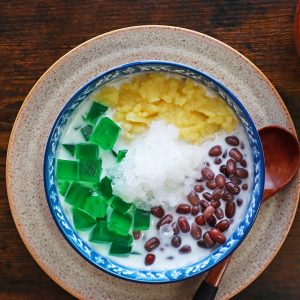
In this version, we’re doing something a little different: instead of stacking the colours in a glass, we arrange them like a pie chart in a shallow serving dish. Not only does this look stunning on the table, it also lets you clearly see how all the ingredients mingle together once you add the ice and pour over the chilled coconut milk sauce.

What Is Vietnamese Three-Colour Dessert (Chè Ba Màu)?
Chè Ba Màu is a classic Vietnamese cold dessert that literally translates to “three-colour dessert.” It’s part drink, part pudding, and 100% refreshing. The three colours each bring their own texture and flavour:
- Green: Fragrant pandan jelly made with agar agar, sliced into strips or cubes
- Yellow: Soft, lightly sweetened mung beans with a hint of vanilla
- Red: Tender red beans soaked in a simple sugar syrup
Everything is topped with shaved ice and a rich, creamy coconut milk and condensed milk sauce, slightly thickened with tapioca starch for a silky finish.
This dessert is incredibly popular in Việt Nam, especially in the hot season. Street stalls, family kitchens, and dessert shops all have their own take on it, but the combination of cool, creamy, chewy, and sweet is always the same.
Why You’ll Love This Version
This particular recipe for Vietnamese Three-Colour Dessert is:
- Luscious and creamy: Thanks to the coconut milk and condensed milk sauce
- Visually stunning: The three colours arranged like a pie chart make it perfect for photos and gatherings
- Texturally satisfying: Soft beans, bouncy jelly, and crunchy shaved ice in every spoonful
- Make-ahead friendly: You can prepare all the layers in advance and assemble just before serving
- Customisable: Adjust the sweetness, jelly shape, or bean texture to your taste
Instead of the usual tall glass, this shallow serving dish presentation allows you to show off the colours more clearly on camera or at the table – ideal if you’re filming, hosting, or simply want to see how beautifully everything blends once mixed.
Q&As on Vietnamese Three-Colour Dessert (Chè Ba Màu)
1. What is agar agar powder?
Agar agar powder is a natural, plant-based gelling agent made from red algae (a type of seaweed). It’s commonly used in Asian desserts and vegan cooking as an alternative to gelatin, which is animal-derived. Compared to gelatin, agar agar sets much more firmly, holds its shape at room temperature, and has a higher melting point, so jellies made with it don’t melt as easily in warm weather.
To use agar agar powder, you typically dissolve it in a liquid such as water, juice, or coconut milk, then bring the mixture to a boil and simmer for a few minutes to fully activate its gelling power; once cooled, it sets quickly into a firm jelly.
Because agar agar is significantly stronger than gelatin, it cannot be substituted in equal amounts – about 1 teaspoon of agar agar powder can replace roughly 8 teaspoons of gelatin, though the texture will be firmer and less bouncy. It is virtually tasteless and odourless, so it won’t interfere with the main flavours of your dessert, and it is very low in calories while providing some dietary fibre, making it a clean-tasting, vegetarian-friendly option for recipes like Vietnamese Three-Colour Dessert.
2. What are pandan leaves, and why are they so popular in Vietnamese desserts?
Pandan leaves come from the pandan plant, a tropical shrub widely used across Southeast Asia, including Việt Nam. They’re long, narrow, blade-like leaves with a distinctive aroma often described as floral, nutty, and slightly vanilla-like. In Vietnamese desserts, pandan leaves are popular because they add both fragrance and a natural green colour to sweet dishes. Fresh pandan leaves are usually tied into knots or blended with water and strained to make pandan juice, which is then used to flavour jellies, sticky rice, cakes, and drinks.
When fresh leaves aren’t available, many home cooks use pandan extract or pandan essence as a convenient substitute. In recipes like Vietnamese Three-Colour Dessert, pandan is what gives the green layer its signature colour and gentle, comforting scent.

3. Can I use canned red beans instead of raw red beans for this recipe?
Yes, you can use canned red beans as a shortcut, but there are a few trade-offs to keep in mind. When you cook raw red beans from scratch, you can control how soft or firm they are, which is important for desserts like Vietnamese Three-Colour Dessert where you want the beans to hold their shape and still have a pleasant bite. Canned red beans, on the other hand, are often quite soft and can sometimes be a bit mushy, so they may not look as neat in the glass or dish. They also won’t taste as fresh as home-cooked beans, since they’re pre-cooked and stored in liquid. If you do use canned beans, drain and rinse them gently, then sweeten them lightly with a simple syrup – just be aware that the texture will be softer and the overall result slightly different from using freshly cooked red beans.
4. Can I make the components of Vietnamese Three-Colour Dessert ahead of time?
Yes, this dessert is very make-ahead friendly, which makes it great for parties or hot days. You can prepare the pandan jelly, sweet mung beans, and red beans a day in advance and store each component in separate airtight containers in the fridge. The jelly will stay firm, and the beans actually taste better once they’ve had time to chill and absorb the sweetness. The coconut milk sauce should also be made ahead and chilled well before serving, as a cold sauce keeps the shaved ice from melting too quickly and makes the dessert extra refreshing. Just wait until the last moment to add the shaved ice and assemble the three colours, so the textures and layers stay clear and vibrant.
5. How do you pronounce “Chè Ba Màu” in Vietnamese?
“Chè Ba Màu” is pronounced roughly like “cheh bah mao” in English.
- Chè (pronounced “cheh”) means a sweet dessert soup, pudding, or drink – this is the general Vietnamese term for many sweet treats served in a bowl or glass.
- Ba (pronounced “bah”) means three.
- Màu (pronounced “mao,” with a rising tone) means colour.
So, “Chè Ba Màu” literally means “Three-Colour Dessert,” referring to the classic combination of green jelly, yellow mung beans, and red beans layered together with ice and coconut milk.
Recipe for Vietnamese Three-Colour Dessert (Chè Ba Màu)
Equipment
- 1 Pot
Ingredients
Green Layer (Pandan Jelly):
- 1 tablespoon agar agar powder
- 2 cups water
- ½ teaspoon pandan extract
- 3 tablespoons sugar
Yellow Layer (Mung Beans):
- 135 grams split mung beans
- 2 cups water
- 3 tablespoons sugar
- 1½ teaspoon vanilla sugar
Red Layer (Red Beans):
- 225 grams red beans (soaked overnight and drained)
- 2 tablespoons sugar
Milk Sauce:
- 1 can coconut milk (400 mL)
- 2 tablespoons condensed milk
- 2 teaspoons tapioca starch
Toppings:
- Shaved ice
- Extra condensed milk (optional, for drizzling)
Instructions
- Prepare the Green Layer (Pandan Jelly):Add 2 cups of water to a pot and set over medium-high heat. Add pandan extract, sugar, and agar agar powder.Stir continuously until the sugar and agar are fully dissolved and the mixture comes to a gentle boil.Pour the hot mixture into a heatproof glass dish or shallow tray.Let it cool and set at room temperature, then transfer to the fridge and chill for at least 4 hours, or until firm.Once fully set, gently loosen the jelly from the dish. Slice into thin strips or small cubes, depending on your preferred look and texture. Keep chilled until assembling.
- Prepare the Yellow Layer (Mung Beans):Rinse the mung beans under cold water until the water runs clearer. Add the mung beans and 2 cups of water to a non-stick pot. Bring to a boil over medium-high heat.Reduce the heat to low and let the beans simmer until soft and most of the water has evaporated, stirring occasionally to prevent sticking. If they look too dry before softening, add a splash of water.When the beans are soft and thick, add the sugar and vanilla sugar. Mix well to dissolve and distribute the sweetness.Stir well, lightly mashing with a spatula or spoon until smooth or to your preferred texture (chunky or smoother paste both work).Remove from heat and transfer the mung beans to a bowl. Let cool to room temperature, then chill if you prefer a firmer layer.
- Prepare the Red Layer (Red Beans):After soaking overnight, drain and rinse the red beans.Add the beans to a pot and cover with fresh water (about 2–3 cm above the beans). Bring to a boil, then reduce to a gentle simmer.Cook until the beans are soft but still holding their shape. Remove from heat, drain well, and transfer to a bowl.In a separate bowl, add 1 cup of hot water and 2 tablespoons sugar. Stir until the sugar is dissolved.Let the syrup cool slightly, then pour it over the cooked red beans. Allow the beans to soak in the syrup for at least 20–30 minutes, then chill until ready to serve.
- Prepare the Milk Sauce:In a pot over medium heat, add coconut milk and condensed milk.Stir well to combine and gently warm. Do not let it come to a full boil.In a small bowl, mix the tapioca starch with 2–3 tablespoons water to make a smooth slurry (no lumps). Slowly pour the slurry into the warm coconut mixture while stirring constantly.Cook until the sauce thickens slightly and is steaming, with a smooth, glossy texture.Remove from heat and let the milk sauce cool to room temperature. Chill in the fridge until cold before serving.
- Assemble:Layer the dessertIn a clear glass or dessert bowl, add:- A spoonful of sweet red beans (red layer)- A spoonful of mung beans (yellow layer)- A spoonful of pandan jelly strips or cubes (green layer)Top generously with shaved ice. Pour the chilled coconut milk sauce over the ice until it almost reaches the rim of the glass.
- Serve:Drizzle a little extra condensed milk on top if you like a richer, sweeter dessert.Mix lightly before eating so you get all three colours and textures in each bite.